Research Physical Human–Robot Interaction
An adaptive admittance controller for collaborative drilling with a robot based on subtask classification via deep learning
Mechatronics, vol. 86, p. 102851, 2022
@article{guler2022adaptive,
  title   = {An adaptive admittance controller for collaborative drilling with a robot based on subtask classification via deep learning},
  author  = {Guler, Berk and Niaz, Pouya P. and Madani, Alireza and Aydin, Yusuf and Basdogan, Cagatay},
  journal = {Mechatronics},
  volume  = {86},
  pages   = {102851},
  year    = {2022}
}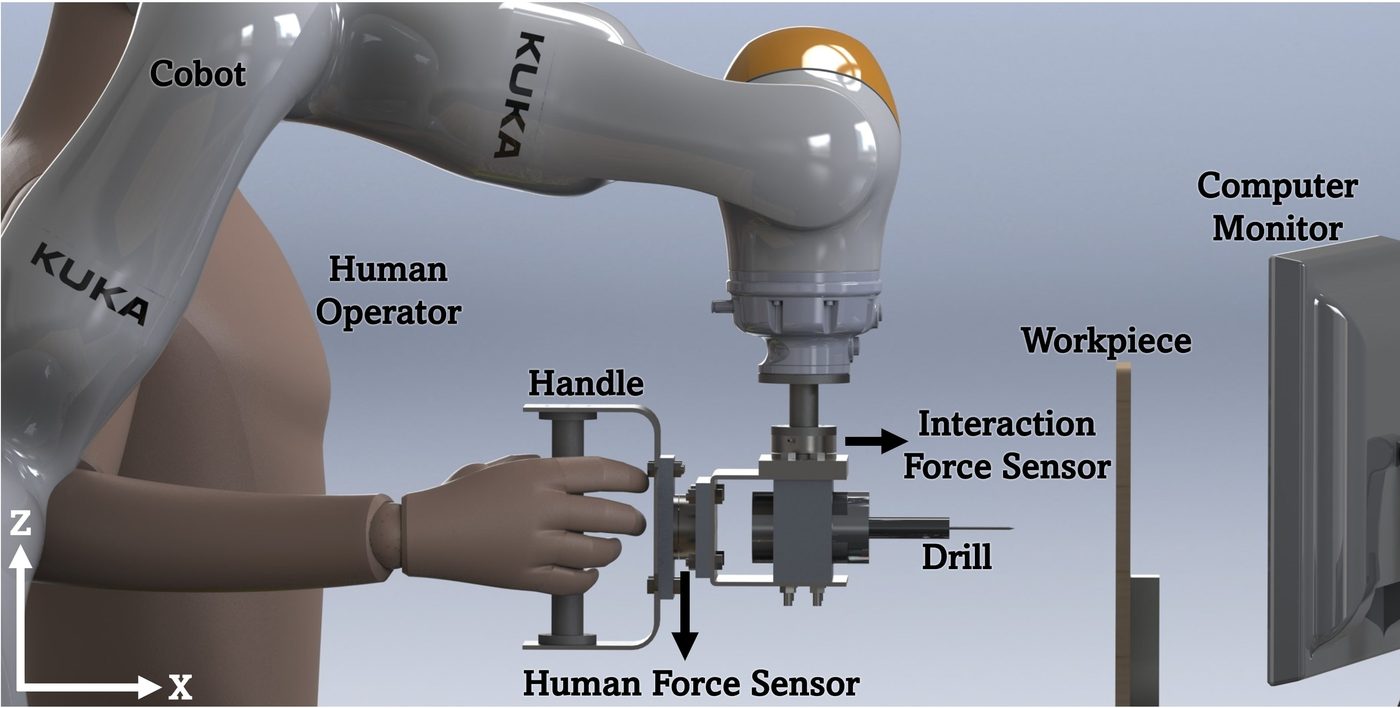
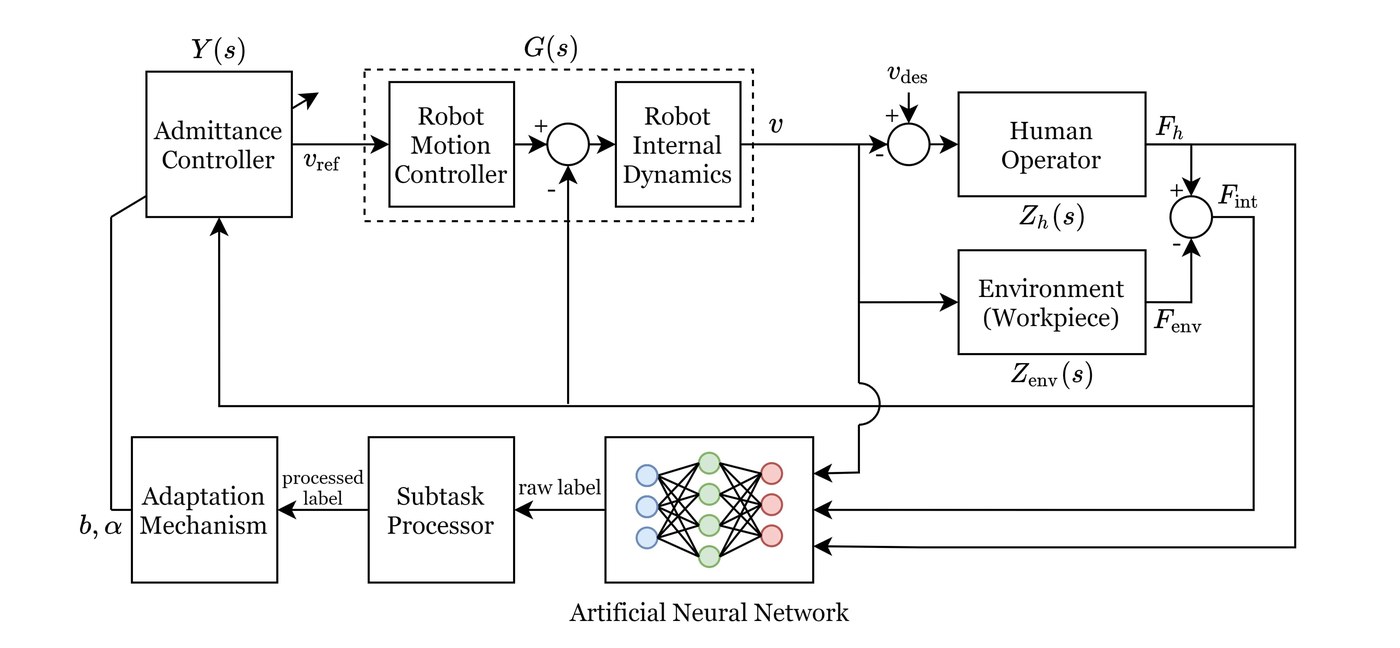
In this paper, we propose a supervised learning approach based on an Artificial Neural Network (ANN) model for real-time classification of subtasks in a physical human-robot interaction (pHRI) task involving contact with a stiff environment. In this regard, we consider three subtasks for a given pHRI task: Idle, Driving, and Contact. Based on this classification, the parameters of an admittance controller that regulates the interaction between human and robot are adjusted adaptively in real time to make the robot more transparent to the operator (i.e. less resistant) during the Driving phase and more stable during the Contact phase. The Idle phase is primarily used to detect the initiation of task. Experimental results have shown that the ANN model can learn to detect the subtasks under different admittance controller conditions with an accuracy of 98% for 12 participants. Finally, we show that the admittance adaptation based on the proposed subtask classifier leads to 20% lower human effort (i.e. higher transparency) in the Driving phase and 25% lower oscillation amplitude (i.e. higher stability) during drilling in the Contact phase compared to an admittance controller with fixed parameters.
AI-generated summary · may contain mistakes, see the paper
In collaborative drilling, the same admittance parameters cannot be both light enough for moving the robot freely and stiff enough for stable contact with the workpiece. A neural network recognizes the current subtask (Idle, Driving, or Contact) from interaction data in real time, and the admittance controller switches its parameters accordingly.
The classifier detects the subtasks with 98% accuracy across 12 participants, and the adaptation lowers human effort while driving by 20% and oscillation amplitude while drilling by 25% compared to fixed parameters.
My contributions
- Developed the control architecture that regulates human-robot physical interaction through an admittance controller on the KUKA iiwa cobot.
- Performed a linear time-varying stability analysis of the pHRI system.
- Developed the deep-learning subtask classifier in
PythonwithTensorFlow. - Developed the methods that adapt the admittance parameters from the classifier's output.
- Built a
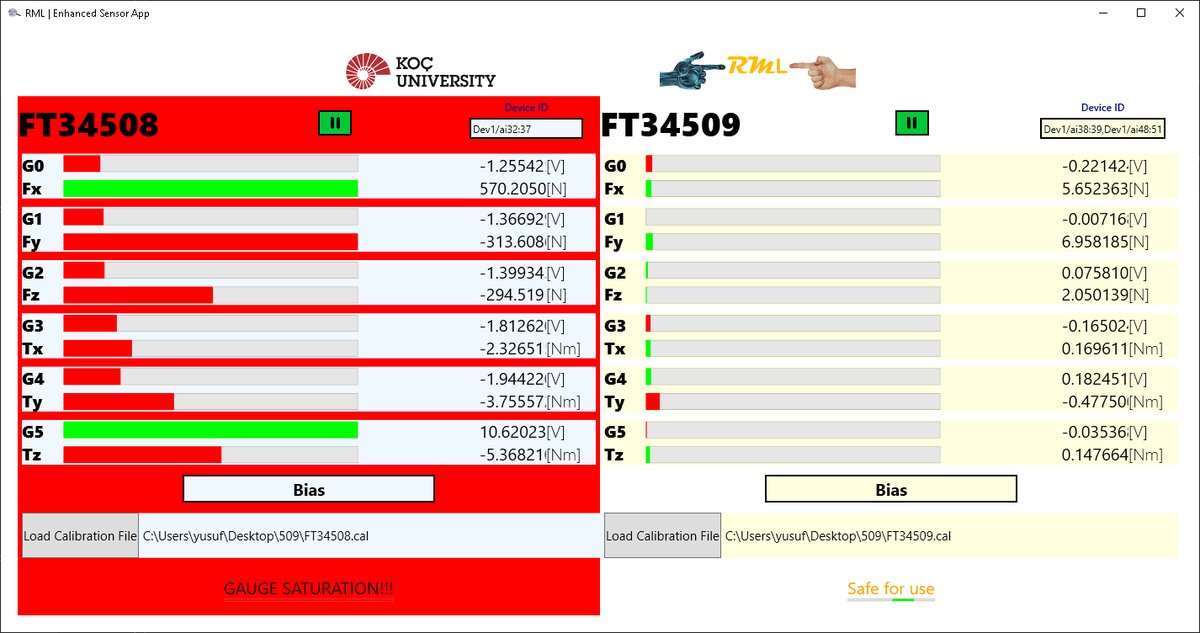
C#GUI to read and record data from ATI force/torque sensors. - Designed the pHRI experiments, collected the data, and performed the statistical analysis.