About me

I am a PhD candidate at the Intelligent Autonomous Systems Lab at TU Darmstadt, advised by Prof. Jan Peters, and I work jointly with Dr. Simon Manschitz at Honda Research Institute Europe. I build assistive teleoperation systems for dexterous manipulation: the robot takes care of safety and precision, and the human stays in charge of the task.

My research spans safety-aware assistive teleoperation and the manipulation and perception of deformable linear objects (DLOs) such as ropes and cables. Before my PhD, I worked on physical human–robot interaction at Koç University and studied control and automation engineering at Istanbul Technical University.

  • Assistive Teleoperation
  • Deformable Linear Objects
  • DLO Perception
  • Physical Human–Robot Interaction
  • Robot Learning
grab the rope

News

Research

Pick a theme. Every card shows the paper's abstract, with an AI summary one click away, and links to a page with media and BibTeX.

Safety-Aware Assistive Teleoperation

How can a robot help a remote operator without taking control away from them? I design assistive teleoperation algorithms that keep the robot safe as a hard constraint and evaluate them in VR teleoperation user studies.

ICRA 2026Safety-aware teleoperation Interactive

A Safety-Aware Shared Autonomy Framework with BarrierIK Using Control Barrier Functions

Berk Guler*, Kay Pompetzki*, Yuanzheng Sun, Simon Manschitz, Jan Peters (* equal contribution)

Shared autonomy blends operator intent with autonomous assistance. In cluttered environments, linear blending can produce unsafe commands even when each source is individually collision-free. Many existing approaches model obstacle avoidance through potentials or cost terms, which only enforce safety as a soft constraint. In contrast, safety-critical control requires hard guarantees. We investigate the use of control barrier functions (CBFs) at the inverse kinematics (IK) layer of shared autonomy, targeting post-blend safety while preserving task performance. Our approach is evaluated in simulation on representative cluttered environments and in a VR teleoperation study comparing pure teleoperation with shared autonomy. Across conditions, employing CBFs at the IK layer reduces violation time and increases minimum clearance while maintaining task performance. In the user study, participants reported higher perceived safety and trust, lower interference, and an overall preference for shared autonomy with our safety filter.

ICRA 2025Assisted teleoperation

Sampling-Based Grasp and Collision Prediction for Assisted Teleoperation

Simon Manschitz, Berk Gueler, Wei Ma, Dirk Ruiken

Shared autonomy allows for combining the global planning capabilities of a human operator with the strengths of a robot such as repeatability and accurate control. In a real-time teleoperation setting, one possibility for shared autonomy is to let the human operator decide for the rough movement and to let the robot do fine adjustments, e.g., when the view of the operator is occluded. We present a learning-based concept for shared autonomy that aims at supporting the human operator in a real-time teleoperation setting. At every step, our system tracks the target pose set by the human operator as accurately as possible while at the same time satisfying a set of constraints which influence the robot's behavior. An important characteristic is that the constraints can be dynamically activated and deactivated which allows the system to provide task-specific assistance. Since the system must generate robot commands in real-time, solving an optimization problem in every iteration is not feasible. Instead, we sample potential target configurations and use Neural Networks for predicting the constraint costs for each configuration. By evaluating each configuration in parallel, our system is able to select the target configuration which satisfies the constraints and has the minimum distance to the operator's target pose with minimal delay. We evaluate the framework with a pick and place task on a bi-manual setup with two Franka Emika Panda robot arms with Robotiq grippers.

Deformable Linear Objects

Ropes and cables have a high-dimensional state, occlude themselves, and tangle. My work spans assistive teleoperation for DLOs, DLO dynamics prediction, and state representations for learning DLO manipulation.

arXiv 2026DLO · Assistive teleoperation Interactive

AssistDLO: Assistive Teleoperation for Deformable Linear Object Manipulation

Berk Guler, Simon Manschitz, Kay Pompetzki, Jan Peters

Manipulating Deformable Linear Objects (DLOs) is challenging in robotics due to their infinite-dimensional configuration space and complex nonlinear dynamics. In teleoperation, depth uncertainty hinders state perception and reaction. AssistDLO addresses this challenge as an assistive teleoperation framework for DLO manipulation that combines real-time multi-view state estimation, visual assistance (VA), and a geometry-aware shared-autonomy controller based on Control Barrier Functions (SA-CBF). While traditional shared autonomy methods often rely on simple geometric attractors and may fail to preserve DLO geometry, SA-CBF acts as a geometry-aware funnel, facilitating precise grasping while preserving the operator's high-level authority. The framework is evaluated in a bimanual knot-untangling user study (N = 22) using ropes with varying length and rigidity. Results show that the effectiveness of the assistance depends strongly on operator expertise and DLO properties. SA-CBF provides the strongest gains for naive users, acting as a skill equalizer that increases task success from 71% to 88%, and is effective for stiffer ropes. Conversely, expert users prefer VA, and highly compliant, long ropes benefit more from visual support than localized action assistance. Ultimately, these findings demonstrate that effective DLO teleoperation cannot rely on a fixed strategy, highlighting the critical need for adaptive, user-aware, and material-aware shared autonomy.

arXiv 2026DLO · Dynamics prediction

ForwardDLO: Model-Based Bimanual Shape Matching of Unconstrained Deformable Linear Objects

Tim Missal, Berk Guler, Lucas Domingues, Simon Manschitz, Jan Peters, Paula Dornhofer Paro Costa

Ropes, cables, and other deformable linear objects appear in tasks from untangling to cable routing and suturing, yet controlling their shape remains a challenge in robot manipulation. We study model-based shape control in a general setting: the object lies unfixated on a support surface and two arms may grasp and move it anywhere along its length. Because each arm chooses a grasp point, direction, and magnitude, the joint action space is combinatorially large, and the dynamics model's per-prediction cost bounds how much of it a planner can search. We present ForwardDLO, a recurrent latent dynamics model for this unfixated bimanual setting that predicts per-segment displacements grounded in the observed rope state at every step. Our model reaches accuracy comparable to more expensive baselines while containing no explicit segment-to-segment operations, which makes batched evaluation of candidate actions cheap. On open-loop prediction of real rope motion it reaches the lowest error of the learned models we evaluate, 13% below the strongest baseline. Within a fixed time budget it scores 8 to 22 times more candidate actions than models of comparable accuracy while matching them in real-world shape matching; and on a simulated routing task at a 30 Hz control rate, this throughput converts into 98% task success versus at most 30% for the baselines at their own budgets. We release the model, code, and a dataset of 2.42 million simulated and 14,107 real rope transitions in the project's repository.

arXiv 2026DLO · Dynamics prediction

RopeDreamer: A Kinematic Recurrent State Space Model for Dynamics of Flexible Deformable Linear Objects

Tim Missal, Lucas Domingues, Berk Guler, Simon Manschitz, Jan Peters, Paula Dornhofer Paro Costa

The robotic manipulation of Deformable Linear Objects (DLOs) is a fundamental challenge due to the high-dimensional, non-linear dynamics of flexible structures and the complexity of maintaining topological integrity during contact-rich tasks. While recent data-driven methods have utilized Recurrent and Graph Neural Networks for dynamics modeling, they often struggle with self-intersections and non-physical deformations, such as tangling and link stretching. In this paper, we propose a latent dynamics framework that combines a Recurrent State Space Model with a Quaternionic Kinematic Chain representation to enable robust, long-term forecasting of DLO states. By encoding the DLO as a sequence of relative rotations (quaternions) rather than independent Cartesian positions, we inherently constrain the model to a physically valid manifold that preserves link-length constancy. Furthermore, we introduce a dual-decoder architecture that decouples state reconstruction from future-state prediction, forcing the latent space to capture the underlying physics of deformation. We evaluate our approach on a large-scale simulated dataset of complex pick-and-place trajectories involving self-intersections. Our results demonstrate that the proposed model achieves a 40.52% reduction in open-loop prediction error over 50-step horizons compared to the state-of-the-art baseline, while reducing inference time by 31.17%. Our model further maintains superior topological consistency in scenarios with multiple crossings, proving its efficacy as a compositional primitive for long-horizon manipulation planning. Code, models and dataset will be released in a future revision.

ICRA Workshop 2026DLO · State representation for learning

Learning Sim-Grounded Policies for Bimanual Rope Manipulation from Human Teleoperation Data

Gina Wigginghaus*, Tim Missal*, Berk Guler, Simon Manschitz, Jan Peters (* equal contribution)

Deformable Linear Objects (DLOs) such as ropes and cables are widely encountered in both household and industrial applications, yet remain challenging to manipulate due to their infinite-dimensional configuration space and frequent self-occlusion. Imitation learning from teleoperation offers a practical path to bimanual DLO manipulation, but its scalability is limited by human effort, making the choice of observation space critical for generalization from small datasets. In this study, we investigate whether the lack of generalization in egocentric visual policies for the knot-untangling task stems from the observation space itself, rather than from the policy architecture or data scale. We compare two Action Chunking with Transformers policies trained on the same bimanual teleoperation data: a vision-based policy conditioned on two egocentric RGB streams from wrist-mounted cameras, and a state-based policy conditioned on the DLO's 3D particle state, extracted from an initial observation via multi-view fusion and evolved in a particle-based eXtended Position-Based Dynamics simulation. Evaluated open-loop on an unseen rope configuration, the state-based policy outperforms its visual counterpart with a 30.8% reduction in L1 error when predicting the initial grasp-and-pull action, quantifying the observability gap between pixels and physics-consistent state, and pointing toward more data-efficient robot learning for the DLO manipulation task from limited human demonstrations.

Physical Human–Robot Interaction

During my M.Sc. at Koç University I developed adaptive admittance controllers, haptic guidance, and learning-based intent estimation for humans and cobots sharing a physical task.

IROS 2022pHRI · Haptic guidance & AR

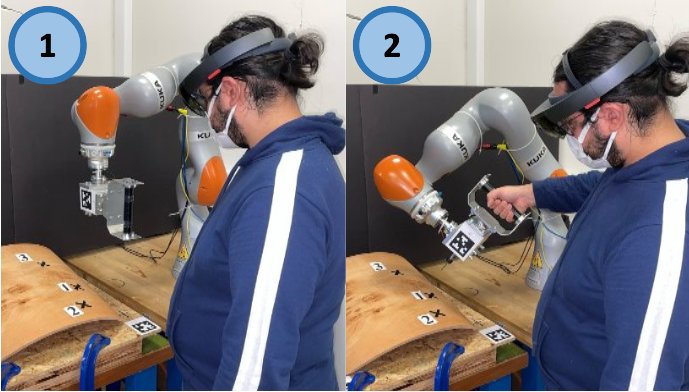
Robot-Assisted Drilling on Curved Surfaces with Haptic Guidance under Adaptive Admittance Control

Alireza Madani, Pouya P. Niaz, Berk Guler, Yusuf Aydin, Cagatay Basdogan

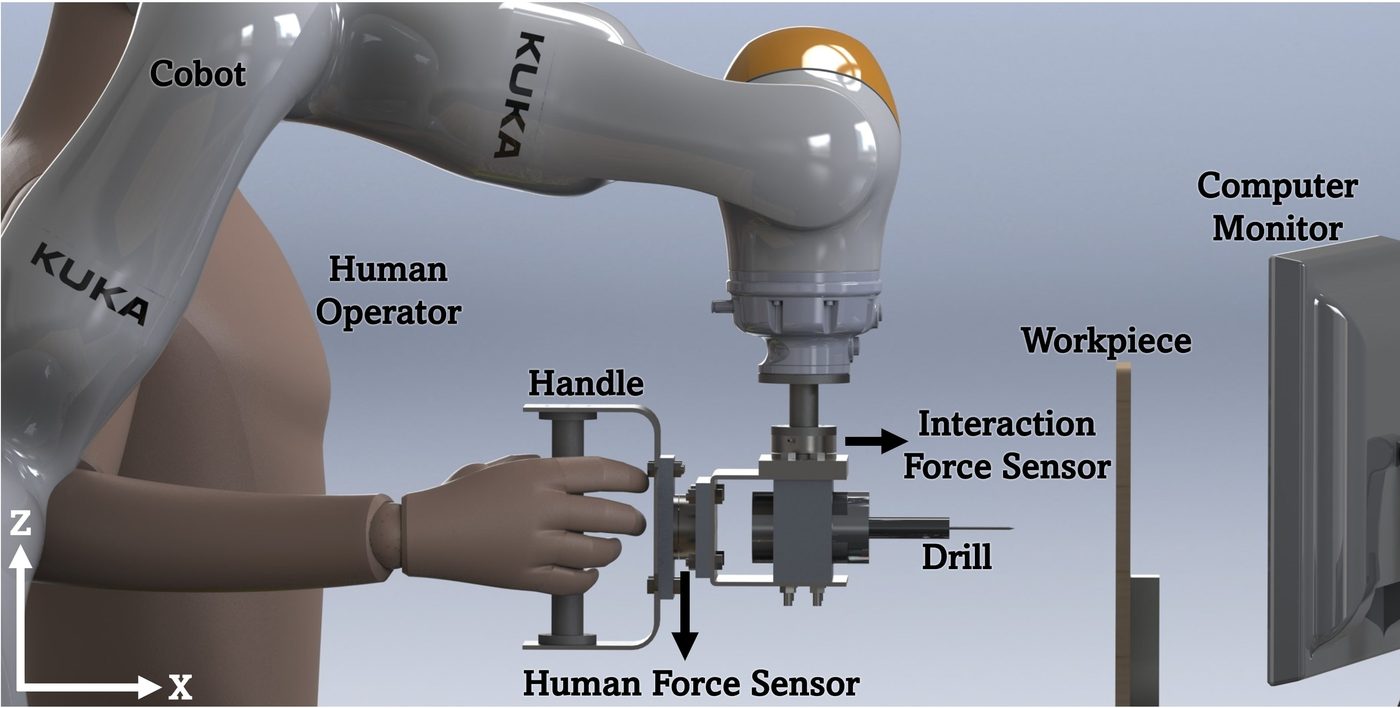
Drilling a hole on a curved surface with a desired angle is prone to failure when done manually, due to the difficulties in drill alignment and also inherent instabilities of the task, potentially causing injury and fatigue to the workers. On the other hand, it can be impractical to fully automate such a task in real manufacturing environments because the parts arriving at an assembly line can have various complex shapes where drill point locations are not easily accessible, making automated path planning difficult. In this work, an adaptive admittance controller with 6 degrees of freedom is developed and deployed on a KUKA LBR iiwa 7 cobot such that the operator is able to manipulate a drill mounted on the robot with one hand comfortably and open holes on a curved surface with haptic guidance of the cobot and visual guidance provided through an AR interface. Real-time adaptation of the admittance damping provides more transparency when driving the robot in free space while ensuring stability during drilling. After the user brings the drill sufficiently close to the drill target and roughly aligns to the desired drilling angle, the haptic guidance module fine tunes the alignment first and then constrains the user movement to the drilling axis only, after which the operator simply pushes the drill into the workpiece with minimal effort. Two sets of experiments were conducted to investigate the potential benefits of the haptic guidance module quantitatively (Experiment I) and also the practical value of the proposed pHRI system for real manufacturing settings based on the subjective opinion of the participants (Experiment II). The results of Experiment I, conducted with 3 naive participants, show that the haptic guidance improves task completion time by 26% while decreasing human effort by 16% and muscle activation levels by 27% compared to no haptic guidance condition. The results of Experiment II, conducted with 3 experienced industrial workers, show that the proposed system is perceived to be easy to use, safe, and helpful in carrying out the drilling task.

Mechatronics 2022pHRI · Subtask recognition

An adaptive admittance controller for collaborative drilling with a robot based on subtask classification via deep learning

Berk Guler, Pouya P. Niaz, Alireza Madani, Yusuf Aydin, Cagatay Basdogan

In this paper, we propose a supervised learning approach based on an Artificial Neural Network (ANN) model for real-time classification of subtasks in a physical human-robot interaction (pHRI) task involving contact with a stiff environment. In this regard, we consider three subtasks for a given pHRI task: Idle, Driving, and Contact. Based on this classification, the parameters of an admittance controller that regulates the interaction between human and robot are adjusted adaptively in real time to make the robot more transparent to the operator (i.e. less resistant) during the Driving phase and more stable during the Contact phase. The Idle phase is primarily used to detect the initiation of task. Experimental results have shown that the ANN model can learn to detect the subtasks under different admittance controller conditions with an accuracy of 98% for 12 participants. Finally, we show that the admittance adaptation based on the proposed subtask classifier leads to 20% lower human effort (i.e. higher transparency) in the Driving phase and 25% lower oscillation amplitude (i.e. higher stability) during drilling in the Contact phase compared to an admittance controller with fixed parameters.

M.Sc. Thesis 2023pHRI · Deep RL Interactive

Deep Reinforcement Learning to Optimize Task Performance in Human-Robot Co-Manipulation

Berk Guler

In industry, complex tasks encourage human operators to work together with robots, and carrying heavy objects is one of them. Using the human's dexterity and intelligence and the robot's precision, we can drive and park heavy objects where the human operator wants without the programming in advance. This study's initial aim is to increase efficiency by understanding human motion intention. However, the human force's response is observed by delay due to the object's weight. Therefore, estimated human intention can help make decisions on amplifying or attenuating the human force. Constantly scaling in one way is not efficient for human effort because of the different phases of the co-manipulation task. Amplification is preferable during driving when attenuation becomes more of an issue for parking. The deep learning model provides an adaptive force scaling factor by referring to human motion intention without guaranteeing optimal human effort and comfort. The model-free optimal control algorithm, deep reinforcement learning, adjusts the existing adaptive force scaling factor to decrease human effort and increase comfort.

Earlier Work

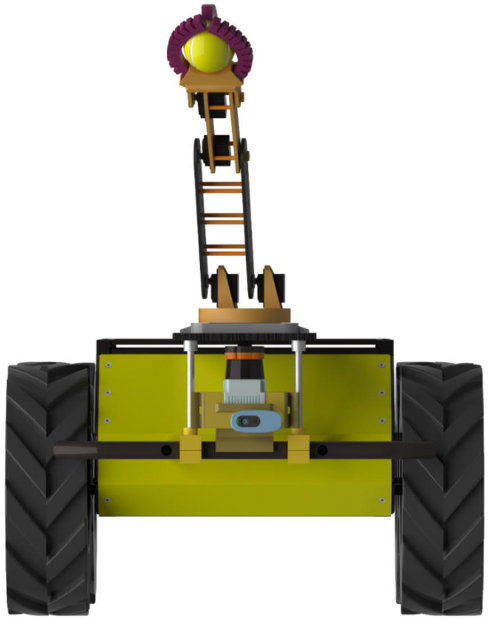
My B.Sc. thesis: an autonomous mobile manipulator with a soft gripper.

B.Sc. Thesis 2020Mobile manipulation

Autonomous Manipulation and SLAM with a Hybrid Mobile Manipulator

Berk Guler

This study demonstrates the soft robotic as a part of the mobile manipulator that executes the defined tasks: autonomous navigation using SLAM, the visual recognition of the marked boxes with ARtags, and pick-and-place manipulation of the objects located on top of the marked boxes.

Publications Google Scholar

Under Review & Preprints

  1. ICRA 2027 · under review

    Intent-Aware Adaptive Admittance Control for Human–Robot Collaborative Transport of Objects

    Berk Guler, E. U. Dincer, O. S. Oguz, Yusuf Aydin, Cagatay Basdogan

    Submitted to the IEEE International Conference on Robotics and Automation (ICRA), 2027

  2. arXiv 2026

    ForwardDLO: Model-Based Bimanual Shape Matching of Unconstrained Deformable Linear Objects

    Tim Missal, Berk Guler, Lucas Domingues, Simon Manschitz, Jan Peters, Paula Dornhofer Paro Costa

    arXiv preprint arXiv:2609.18455, 2026 ·

  3. arXiv 2026

    AssistDLO: Assistive Teleoperation for Deformable Linear Object Manipulation

    Berk Guler, Simon Manschitz, Kay Pompetzki, Jan Peters

    arXiv preprint arXiv:2605.06323, 2026 ·

  4. arXiv 2026

    RopeDreamer: A Kinematic Recurrent State Space Model for Dynamics of Flexible Deformable Linear Objects

    Tim Missal, Lucas Domingues, Berk Guler, Simon Manschitz, Jan Peters, Paula Dornhofer Paro Costa

    arXiv preprint arXiv:2604.28161, 2026

Conference Papers

  1. ICRA 2026

    A Safety-Aware Shared Autonomy Framework with BarrierIK Using Control Barrier Functions

    Berk Guler*, Kay Pompetzki*, Yuanzheng Sun, Simon Manschitz, Jan Peters (* equal contribution)

    IEEE International Conference on Robotics and Automation (ICRA), 2026

  2. ICRA 2025

    Sampling-Based Grasp and Collision Prediction for Assisted Teleoperation

    Simon Manschitz, Berk Gueler, Wei Ma, Dirk Ruiken

    IEEE International Conference on Robotics and Automation (ICRA), 2025

  3. GRC 2025

    Towards Assistive Teleoperation for Knot Untangling

    Berk Guler, Kay Pompetzki, Simon Manschitz, Jan Peters

    German Robotics Conference (GRC), 2025

  4. IROS 2022

    Robot-Assisted Drilling on Curved Surfaces with Haptic Guidance under Adaptive Admittance Control

    Alireza Madani, Pouya P. Niaz, Berk Guler, Yusuf Aydin, Cagatay Basdogan

    IEEE/RSJ International Conference on Intelligent Robots and Systems (IROS), 2022

Journal Articles

  1. Mechatronics 2022

    An adaptive admittance controller for collaborative drilling with a robot based on subtask classification via deep learning

    Berk Guler, Pouya P. Niaz, Alireza Madani, Yusuf Aydin, Cagatay Basdogan

    Mechatronics, vol. 86, p. 102851, 2022

Workshop Papers

  1. ICRA Workshop 2026

    Learning Sim-Grounded Policies for Bimanual Rope Manipulation from Human Teleoperation Data

    Gina Wigginghaus*, Tim Missal*, Berk Guler, Simon Manschitz, Jan Peters (* equal contribution)

    ICRA Workshop on Beyond Teleoperation, 2026

Theses

  1. M.Sc. Thesis 2023

    Deep Reinforcement Learning to Optimize Task Performance in Human-Robot Co-Manipulation

    Berk Guler

    M.Sc. Thesis, Koç University, 2023

Education

  1. Ph.D. in Computer Science

    Jul 2023 – present

    Technical University of Darmstadt

    Intelligent Autonomous Systems Lab (IAS) · jointly with Honda Research Institute Europe

    Advisors: Prof. Jan Peters (TU Darmstadt) and Dr. Simon Manschitz (Honda Research Institute Europe)

    Research: autonomy-infused teleoperation for dexterous object manipulation.

  2. M.Sc. in Mechanical Engineering

    Sep 2020 – Jun 2023

    Koç University, Istanbul

    Robotics and Mechatronics Laboratory (RML) · KUIS AI Center

    Advisor: Prof. Çağatay Başdoğan

    Physical human–robot interaction, optimal control for pHRI, and robot learning. Thesis: Deep Reinforcement Learning to Optimize Task Performance in Human-Robot Co-Manipulation.

  3. B.Sc. in Control and Automation Engineering

    Sep 2015 – Jul 2020

    Istanbul Technical University

    Control and Automation Engineering Department

    Advisor: Prof. Hakan Temeltaş

    Thesis: a hybrid mobile manipulator combining rigid and soft subsystems (project).

Teaching & Service

Teaching

  • Robot Learning TU Darmstadt Fall 2023
  • Dynamic Modeling and Control Koç University · Teaching assistant Spring 2021, Spring 2022
  • Mechanical Engineering Design Koç University · Teaching assistant Fall 2020, Fall 2021
  • Object-Oriented Programming Istanbul Technical University · Undergraduate teaching assistant Fall 2019

Reviewing

Reviewer for:

  • RA-L IEEE Robotics and Automation Letters
  • ICRA IEEE International Conference on Robotics and Automation
  • T-MECH IEEE/ASME Transactions on Mechatronics