Research Safety-Aware Assistive Teleoperation
A Safety-Aware Shared Autonomy Framework with BarrierIK Using Control Barrier Functions
IEEE International Conference on Robotics and Automation (ICRA), 2026
@inproceedings{guler2026barrierik,
  title     = {A Safety-Aware Shared Autonomy Framework with {BarrierIK} Using Control Barrier Functions},
  author    = {Guler, Berk and Pompetzki, Kay and Sun, Yuanzheng and Manschitz, Simon and Peters, Jan},
  booktitle = {IEEE International Conference on Robotics and Automation (ICRA)},
  year      = {2026}
}
Shared autonomy blends operator intent with autonomous assistance. In cluttered environments, linear blending can produce unsafe commands even when each source is individually collision-free. Many existing approaches model obstacle avoidance through potentials or cost terms, which only enforce safety as a soft constraint. In contrast, safety-critical control requires hard guarantees. We investigate the use of control barrier functions (CBFs) at the inverse kinematics (IK) layer of shared autonomy, targeting post-blend safety while preserving task performance. Our approach is evaluated in simulation on representative cluttered environments and in a VR teleoperation study comparing pure teleoperation with shared autonomy. Across conditions, employing CBFs at the IK layer reduces violation time and increases minimum clearance while maintaining task performance. In the user study, participants reported higher perceived safety and trust, lower interference, and an overall preference for shared autonomy with our safety filter.
AI-generated summary · may contain mistakes, see the paper
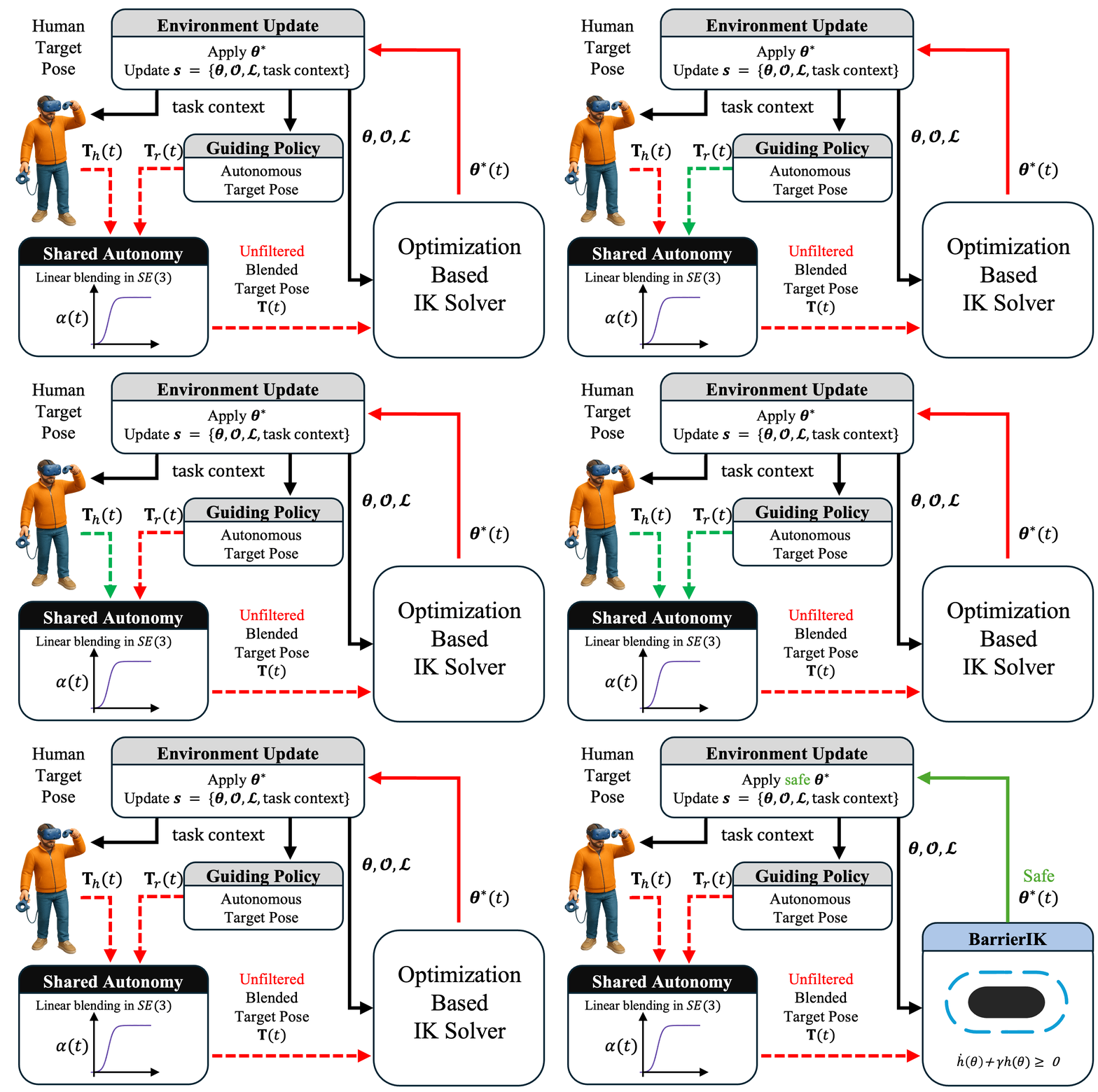
When a teleoperation system blends the operator's command with autonomous assistance, the blended command can collide with obstacles even if both inputs were individually safe. Most prior approaches only discourage collisions through potentials or cost terms, i.e. as a soft constraint. BarrierIK embeds control barrier functions (CBFs) directly into the inverse kinematics (IK) solver, so the post-blend command is safe by construction while the solver still tracks the target pose, respects joint limits, and stays smooth.
In cluttered simulation scenes, filtering blended commands through CBFs at the IK layer reduces safety-violation time and increases minimum clearance without hurting task performance. In a VR teleoperation user study, participants reported higher perceived safety and trust, less interference, and preferred assistance with the safety filter.
Try it: blending with and without a barrier
Steer the arm to the orange block with your pointer. With Shared autonomy your target is pulled toward the block, and the pull can drag the arm through an obstacle even though neither you nor the autonomy aimed at it. Compare what each IK solver does with the blended target, try the Narrow gap scene, or drag the obstacles and the block around.
your target blended target safety margin closest link–obstacle pair
| Run | Reached | Min clearance | In collision | Inside margin |
|---|
A planar toy with the structure of the paper's pipeline, not its implementation: your target and the autonomous target (the block) are blended linearly, with a sigmoid of their distance as the weight, and an inverse-kinematics step turns the result into joint motion. Baseline N ignores obstacles, Baseline P adds a proximity penalty to the objective, and BarrierIK adds control barrier function constraints ∇h·Δθ + γh ≥ 0 for every link–obstacle pair, so it never moves deeper into the safety margin. Each step is a small quadratic program solved in your browser (Hildreth's method) instead of the paper's SLSQP solver; the numbers come from this toy, not from the paper.
My contributions
- Formulated and implemented
BarrierIK, a CBF-constrained IK solver that enforces post-blend safety as a hard inequality constraint alongside standard IK objectives. - Designed and ran the simulation benchmarks in cluttered environments, measuring safety-violation time and minimum clearance against baseline blending.
- Designed and conducted the VR teleoperation user study comparing pure teleoperation with CBF-filtered assistance.
- Analyzed the objective (clearance, violation time, task performance) and subjective (trust, perceived safety, interference) results.
- Released the ROS implementation and the Unity simulation and VR teleoperation framework.
Video
More on the project page.