Research Physical Human–Robot Interaction
Robot-Assisted Drilling on Curved Surfaces with Haptic Guidance under Adaptive Admittance Control
IEEE/RSJ International Conference on Intelligent Robots and Systems (IROS), 2022
@inproceedings{madani2022drilling,
  title     = {Robot-Assisted Drilling on Curved Surfaces with Haptic Guidance under Adaptive Admittance Control},
  author    = {Madani, Alireza and Niaz, Pouya P. and Guler, Berk and Aydin, Yusuf and Basdogan, Cagatay},
  booktitle = {IEEE/RSJ International Conference on Intelligent Robots and Systems (IROS)},
  year      = {2022}
}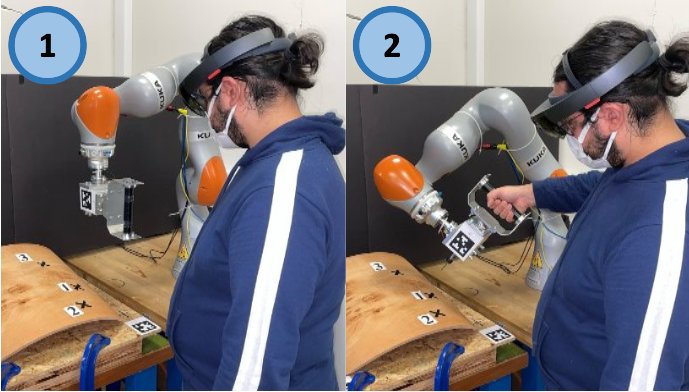
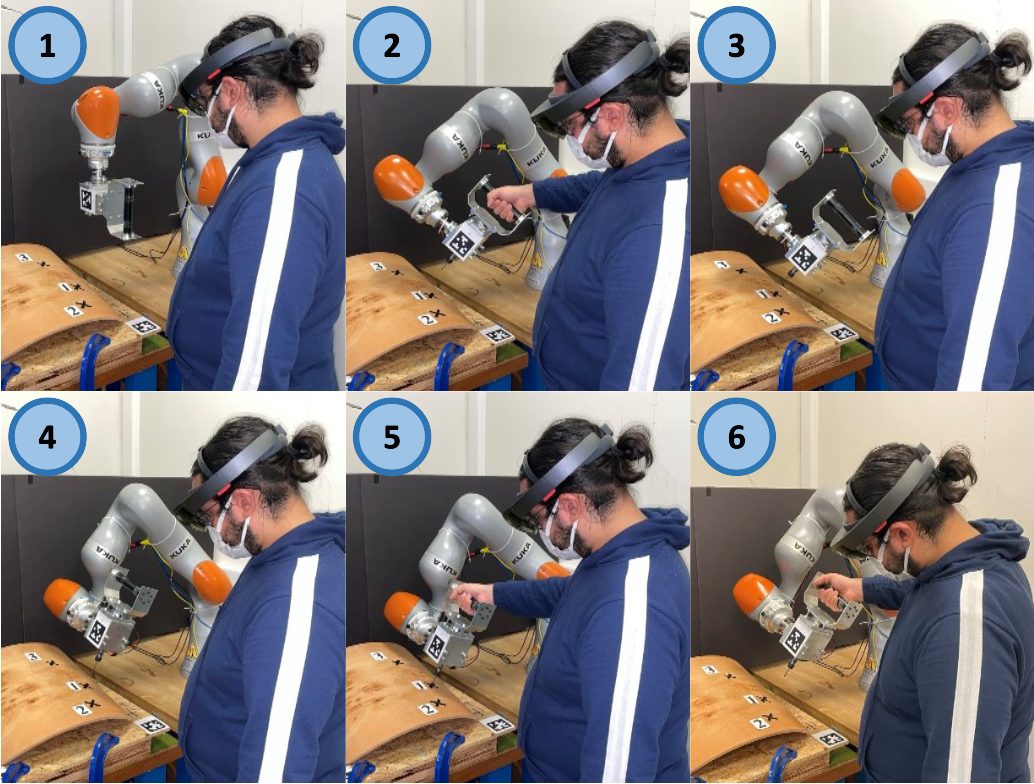
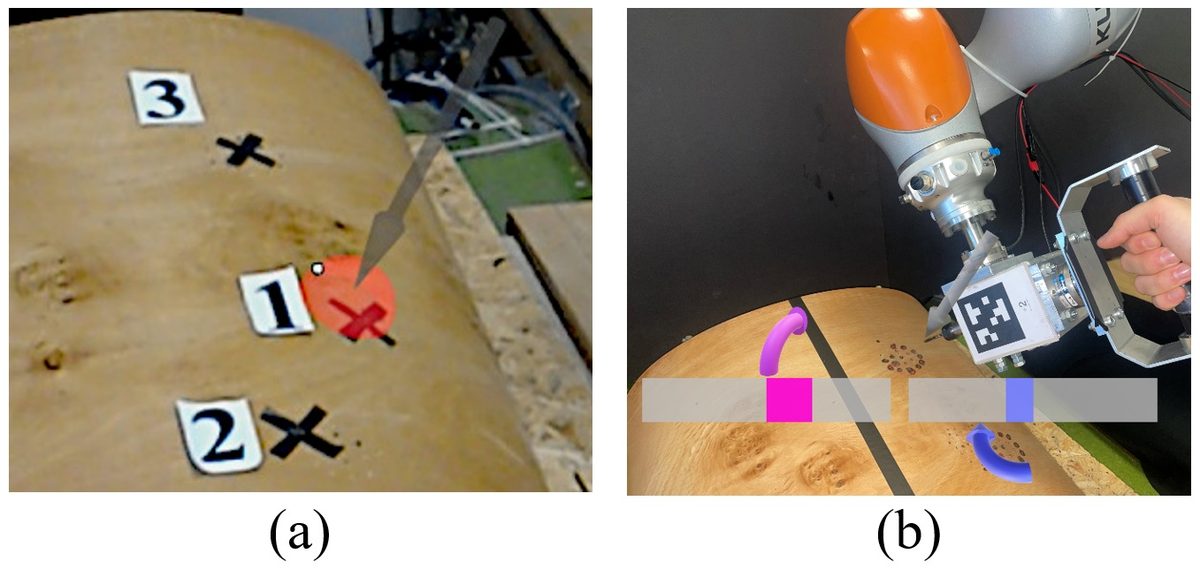
Drilling a hole on a curved surface with a desired angle is prone to failure when done manually, due to the difficulties in drill alignment and also inherent instabilities of the task, potentially causing injury and fatigue to the workers. On the other hand, it can be impractical to fully automate such a task in real manufacturing environments because the parts arriving at an assembly line can have various complex shapes where drill point locations are not easily accessible, making automated path planning difficult. In this work, an adaptive admittance controller with 6 degrees of freedom is developed and deployed on a KUKA LBR iiwa 7 cobot such that the operator is able to manipulate a drill mounted on the robot with one hand comfortably and open holes on a curved surface with haptic guidance of the cobot and visual guidance provided through an AR interface. Real-time adaptation of the admittance damping provides more transparency when driving the robot in free space while ensuring stability during drilling. After the user brings the drill sufficiently close to the drill target and roughly aligns to the desired drilling angle, the haptic guidance module fine tunes the alignment first and then constrains the user movement to the drilling axis only, after which the operator simply pushes the drill into the workpiece with minimal effort. Two sets of experiments were conducted to investigate the potential benefits of the haptic guidance module quantitatively (Experiment I) and also the practical value of the proposed pHRI system for real manufacturing settings based on the subjective opinion of the participants (Experiment II). The results of Experiment I, conducted with 3 naive participants, show that the haptic guidance improves task completion time by 26% while decreasing human effort by 16% and muscle activation levels by 27% compared to no haptic guidance condition. The results of Experiment II, conducted with 3 experienced industrial workers, show that the proposed system is perceived to be easy to use, safe, and helpful in carrying out the drilling task.
AI-generated summary · may contain mistakes, see the paper
Drilling into a curved surface at a precise angle is hard by hand, and full automation is often impractical because parts vary and drill points are not always reachable by a pre-planned path. Here the operator moves a cobot-mounted drill with one hand. The admittance damping adapts to the task phase (light while moving freely, stiffer near the target and during drilling), haptic guidance aligns the drill and then constrains motion to the drilling axis, and a HoloLens AR interface shows targets and alignment cues.
With haptic guidance, three naive participants finished faster, with less effort and lower forearm muscle activation; three experienced industrial workers rated the system easy to use, safe, and helpful.
Key results
- 26%shorter task completion time with haptic guidance
- 16%less human effort
- 27%lower forearm muscle activation (sEMG)
My contributions
- Developed an admittance controller in
C++using the Fast Robot Interface (FRI) of the KUKA iiwa cobot. - Developed the mixed-reality interface in
C#for Microsoft HoloLens with Unity and the Mixed Reality Toolkit (MRTK). - Implemented a Kalman filter to track the 6-DoF motion of the HoloLens and the workpiece from AprilTag fiducial markers.
- Built a 3D mesh model of the workpiece with a depth camera (Microsoft Kinect).
- Set up TCP communication between the robot and the HoloLens.
Experiment